
‘In the huddle’: Champ Burton’s 27 years of giving back
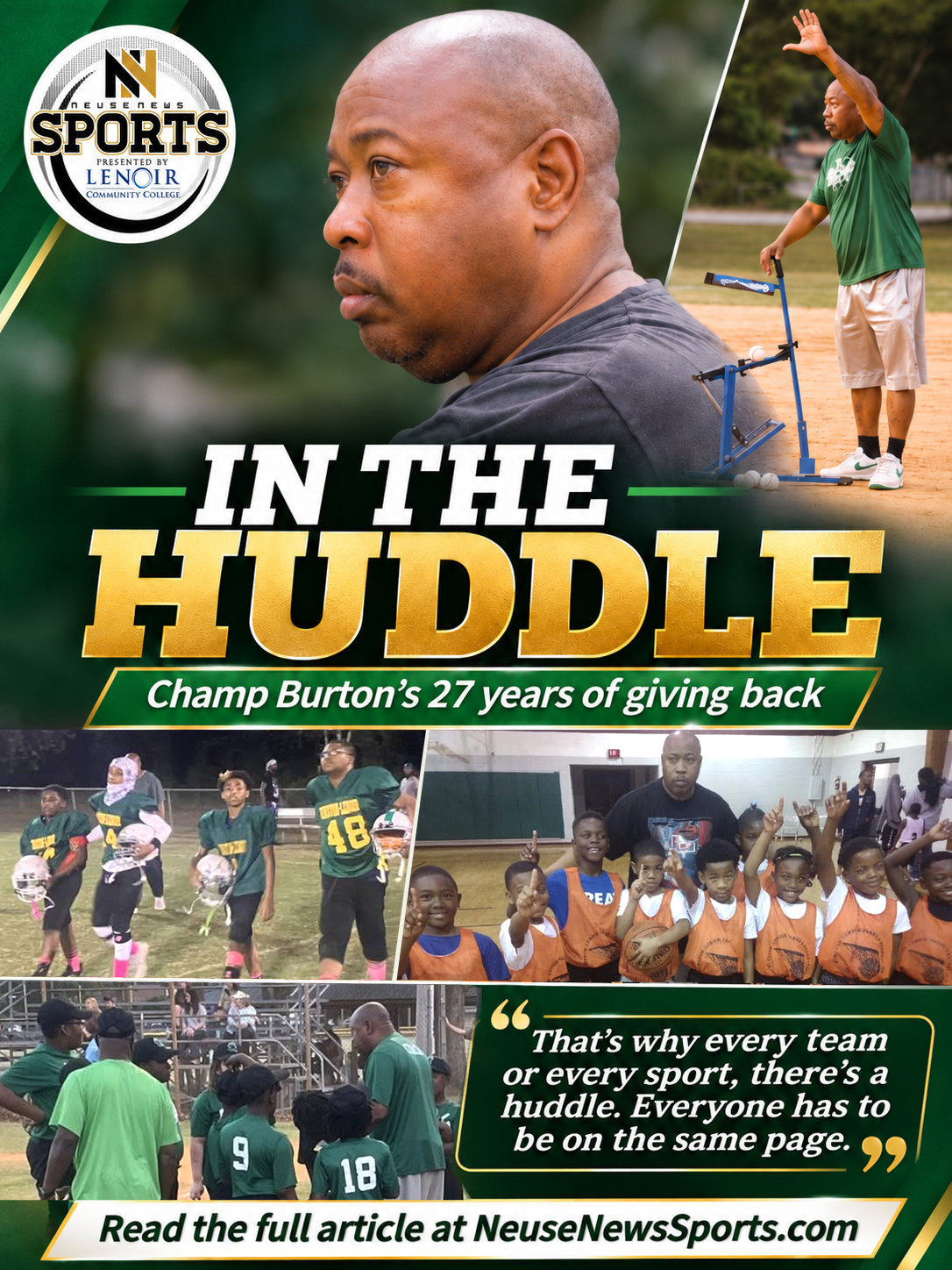
After another championship season, Clarence “Champ” Burton reflects on the people who guided him, the children who keep him going and the generations now giving back to Holloway.
KINSTON - Clarence “Champ” Burton has coached long enough to watch children become adults, former players become coaches and his own sons begin doing the work they grew up watching him do.
This fall, his Holloway 12U football team gave him another reason to celebrate, finishing 6-0 and winning city and county championships.
But ask Burton about 27 years of volunteering, and the conversation moves well beyond an undefeated season.
He talks about children whose circumstances adults might not understand. He talks about parents working long hours, the people who help him put together cookouts and the responsibility of staying involved after a season ends.
Most of all, he talks about family.
“They’ll trust you, they’ll open up to you,” Burton said.
For Burton, that trust helps explain the championships. More importantly, it explains why he keeps coming back.
Someone brought him in
Burton did not grow up expecting to become a fixture at Holloway. He did not grow up in Kinston at all.
He is from Washington, D.C., where he remembers being a young person with athletic ability but not always the direction to put it to good use. He boxed, spent time in the streets and got into fights.
When he looks at some of the children he coaches, he recognizes parts of himself.
“I’m the same kind of kid,” Burton said.
He remembers a woman named Sally Story stepping into the middle of a fight and grabbing his arm. She helped connect him to a place where sports could become something more than a way to pass the time.
“Out the blue, she came in in the middle of the fight and grabbed my arm,” Burton said. “And she took me to the Metropolitan Police Boys and Girls Club. And I was there ever since.”
That experience stayed with him.
Burton’s involvement in youth sports eventually became coaching, and he brought that commitment with him when he moved to North Carolina.
Here, he credits the late Jesse Miller with introducing him to the recreation department.
“He’s the first one brought me to the recreation department. I was just coaching street ball and stuff like that. And he introduced me to the rec,” Burton said.
Miller helped bring that work into organized recreation. Twenty-seven years later, Burton still makes a point of remembering who opened the door.
Asked whether he ever imagined volunteering this long, his answer was immediate.
“No, sir.”
The years were not something he mapped out at the beginning. He liked the games, and he kept coaching.
Along the way, the children gave him reasons to stay.
‘The kids want to play for me’
One of Burton’s most important lessons has been learning to look beyond a child’s behavior.
A young person who seems difficult might be carrying something a coach cannot see. Burton spoke about parents working long shifts, children depending on meals at school and the uncertainty of what happens after they leave a practice or game.
He was careful not to frame those challenges as an indictment of parents. His point was that a coach does not always know the full story.
“You don’t know what they going home to,” Burton said.
That understanding changed the way he approached the children in front of him. He wanted them to feel they belonged to more than a roster.
When a child feels like part of a family, Burton said, trust becomes possible. The child may begin talking, listening and believing that the adult giving instructions is also someone who cares.
Burton does not explain his success simply by claiming to be the best coach.
“The kids want to play for me,” he said.
“If a kid want to play for you, he’s gonna win.”
For Burton, building that relationship means being present for more than one season.
Football cannot be the only time a child matters. When it ends, there is basketball. Then there is baseball. The sport changes, but Burton wants the connection to continue.
“You get them out of one sport and take them right to the next sport because you got to keep it going,” he said. “So you got to keep them with you and keep them on right track.”
He does not want to coach a child through the fall, disappear for months and then reconnect only when football returns. Staying involved gives him more opportunities to encourage young people and help keep them moving in a positive direction.
That sense of family also comes with expectations.
Burton said he talks with parents about supporting the standards he sets for their children. He emphasized that discipline does not mean physical punishment. It means being able to correct behavior and maintain responsibility for a group, especially when traveling to games.
“If I can’t discipline your kid, I can’t coach them because some of these games is out of town. And if your kid get out of hand or get hurt or something, you looking right at me,” he said.
To Burton, caring about children and holding them accountable belong together. So does having the adults around them working toward the same goal.
A former player, his son and a full-circle return
Burton is proud of the young people who have gone on to college. He wants them to build careers and find opportunities.
He also wants their success to reach back into the community that helped raise them.
The Parson family offers a connection that stretches across generations.
Isaac “IP” Parson, the son of Tad Parson, played point guard at Kinston before continuing his college basketball career at Winston-Salem State and North Carolina Central.
Now Isaac is the site director at Holloway Recreation Center.
Burton’s connection to the family began with Isaac’s father.
“When his daddy first moved in North Carolina, came to Kinston, his daddy played for me. I coached his daddy all the way up till he graduated,” Burton said.
The relationship lasted beyond Tad’s playing days. Burton has watched him coach, raise his children and continue giving back.
When Burton introduces Tad to people, he has a description that says more about their relationship than a list of teams or seasons could.
“That’s my oldest son.”
Now Tad’s son is helping lead the recreation center where Burton has devoted so much of his time.
For Burton, that matters. He wants young people to succeed, but he also wants them to return with something to offer the next child.
Watching another generation come back to teach, coach and serve is the kind of outcome he hopes his work can help produce.
“That’s good for his son to come back and try to play and do the same thing that I want his daddy to do — play ball, coaching, teaching fundamentals and stuff like that,” Burton said. “That was amazing. That was something to think about.”
His sons grew up beside him
Burton’s own children did not have to wonder where their father spent his time.
They were with him.
“Everywhere I went, they went,” he said.
If he was involved in boxing, they came along. If he was coaching basketball or baseball, they were there, too.
Sports were part of their family’s routine, and so was being around other children who needed instruction, encouragement and someone willing to show up.
His son CB “Daddy Man” Burton played basketball at Kinston and Pitt Community College. He recently helped coach Holloway’s baseball team to a championship season, taking on some of the same responsibilities he watched his father carry.
Burton said he encouraged CB to coach because he knew the game.
He also spoke proudly of “Lil Champ” following him into boxing and of another son serving in the Navy. Their paths have not all been identical, but Burton’s presence in their lives was intentional.
He wanted his children beside him, learning through what they saw as much as what he told them.
There is another family connection, too.
“All our name is Clarence,” Burton said.
Now, as his sons coach and officiate, Burton can see parts of his example continuing through them.
His approach to helping other people’s children began with the responsibility he felt toward his own.
“I kept the kids in sports because I said, if I can do my kids, I could do somebody else’s kid,” Burton said.
He kept his sons involved. He believed other children deserved that same kind of attention.
The community behind the coach
Burton does not tell the story of Holloway as though he built it by himself.
He remembers the coaches, staff members and supporters who made the recreation center feel like a family to him.
He credited Alexander “Skeet” Davis and Robert Murphy with helping teach him to officiate. Learning the rules from that side of the game gave him a foundation he could later use as a coach.
“So when you get on the other side of that coin, it’s smooth sailing because I already know what to do,” Burton said. “I know how far I can go, what I can do.”
Understanding what officials were looking for helped him understand what to teach his players.
The help has extended beyond the field and court.
When Burton organizes cookouts and other activities for children, people step forward. He spoke about the supporters who help make those gatherings possible and the relationships that have sustained his work.
He recalled Bill Ellis standing up for him when a misunderstanding arose over hot dogs Burton said he was giving away during a softball event.
The details of that memory still matter to Burton because they represent something larger: When he has tried to do something for the community, other people have helped him do it.
“I had a lot of backup. I ain’t just doing stuff on my own,” he said.
His faith is part of how he understands that support.
“But with God, he’ll make sure you get that money,” Burton said.
He described the help that arrives through others as “people in your season for a reason.”
Burton may be the person children see coaching, but he knows there are people behind him making that work possible.
The community has not simply received his time. It has helped him keep giving it.
The children keep him moving
Twenty-seven years have included challenges of his own.
Burton discussed diabetes and kidney-related health problems, saying his health once caused him to step away for a year.
But coaching also gives him a reason to stay active.
He believes teaching sometimes requires more than explaining a drill or pointing toward a spot on the field. Children need to see what he is asking them to do.
“You can’t tell them run left or run this pattern. You got to run the pattern,” Burton said. “The kids keep me in shape. And that keeps my health in check.”
Demonstrating those movements keeps him involved physically, not just as a voice giving directions.
It is one of the ways the relationship works in both directions. Burton gives the children his time and attention. Working with them helps keep him moving.
As the interview ended, he said he was preparing to go into therapy. His own health needs remain part of his daily life, alongside the coaching and community work.
Volunteering also gives him a different way of talking about retirement.
“When you volunteer, you can’t quit or retire,” Burton said. “You don’t have no pension coming.”
After 27 years, his explanation for continuing still comes back to the people around him and the children in front of him.
‘Everybody has to be on the same page’
Asked for a final message, Burton returned to the idea that had run through the entire conversation.
Coaching a child cannot be one person’s responsibility.
“It has to be a family thing,” he said.
Parents, coaches, recreation staff and teachers all have a place in it. Saying children need a family or a village is not enough, he said, unless those adults actually work together.
“Everybody has to be on the same page,” Burton said. “That’s why every team or every sport, there’s a huddle.”
For Burton, the huddle is a way to explain what he wants from the adults around his players: to come together, understand their responsibilities and help the children succeed.
A perfect season gives Holloway something to celebrate. The work Burton describes continues after the final game.
He had one more way to explain it.
“And if I was a preacher,” Burton said, “that would be my sermon in the huddle.”